In a lot of the horror I watch these days, I tend to look more for originality than anything else. I pay close attention to mood, atmosphere, and clever new modes of navigation on the old familiar tropes, but the biggest thing I look for is a new spin on the genre completely. Below are some of the 10 best that come to mind. There is really no ranking here, as it's hard to place a tag on which effort is more creative than the other.
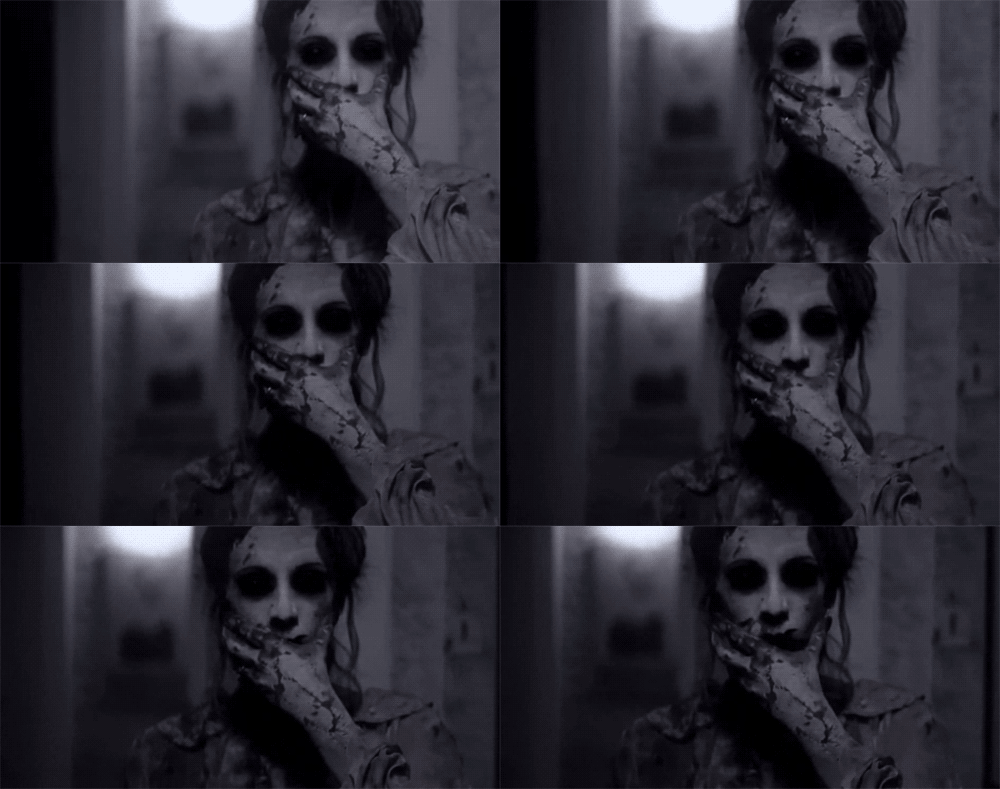
I Am the Pretty Thing That Lives In the House (2016) (Category: Paranormal) This was the first horror movie I had ever seen to delve completely into the damaged, confused psyche of an apparition. It's basically a character study in the midst of a slow-burn, atmospheric ghost story, but for the first time, writer/director Oz Perkins shifted into the mindset of an wayward spirit with haunting, poetic prose narration and a score that's cold and unsettling. Perkins takes the paranormal ghost story and flips it on its head here.
The Descent (2005) (Category: Creature Feature) The premise isn't really all that original, but the casting decisions are. The only male we really see comes as a short, snippet means to an end, giving background information and character development for the lead, Sarah. The movie, tough as nails and bloody as heck, is carried by an all female cast, battling a brood of humanoid bat-like creatures down in the bowels of the earth. The twist ending also alludes to the fact that we're not only trapped in a creature feature, but a paranormal haunter as well.
The Last Shift (2015) (Category: Paranormal/Psychological/Cults) Writer/director Anthony DiBlasi makes indie horror gems in his sleep, including this one, Extremity, and the little-known psychological torture-twister, Dread. His first, The Last Shift, takes the Manson Family, throws them into a satanic blender, and tosses in an ounce of ghost story. The end result is every bit as brilliant as it sounds.
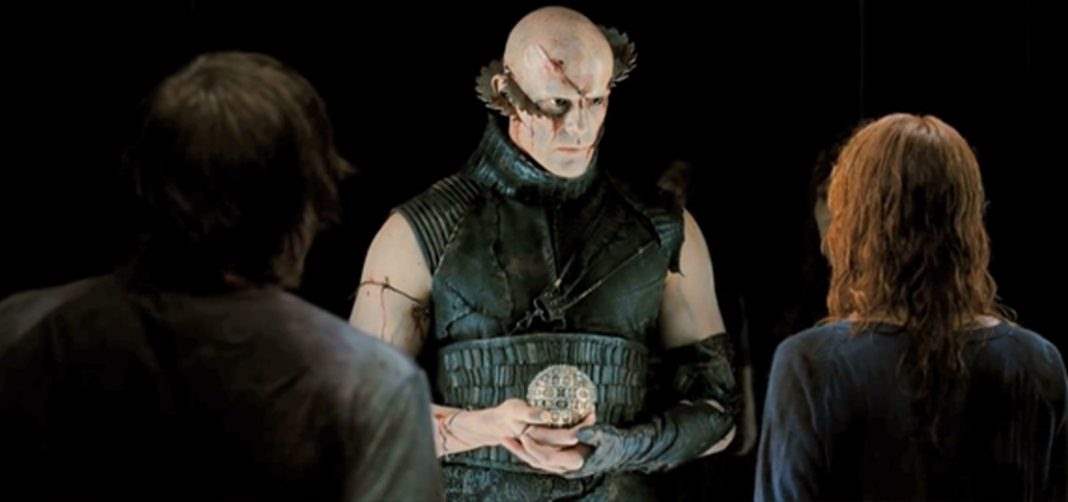
Frankenstein's Army (2013) (Category: Creature Feature/Found-Footage) Frankenstein's Army is an original take on the found-footage sub-genre, taking a group of Soviet soldiers through the wartime horrors of dead soldier reanimation. There's nothing worse than a Nazi, except for maybe a walking dead Nazi fused to iron claws, plane propellers, and industrial-sized drills. This is one of those "what am I watching"-type flicks, but one in which you find yourself surprisingly charmed by the time the credits role.
Mortal Remains (2013) (Category: Found-Footage/Mockumentary) Mortal Remains is based on the lore surrounding the lost black and white horror film, Fury of the Demon. The film explores the defamed legend of the infamous gore director Karl Atticus, who supposedly used real corpses in his movies, which have been banned and have disappeared completely. Interviews reveal the eerie mystique of Atticus and his film adaptations of an Anton LeVey/Aleister Crowley-inspired occultist author. This really plays more like a documentary than a movie, which is a brilliant approach.
The Blackcoat's Daughter (2015) (Category: Psychological/Demons) The Blackcoat's Daughter is about as organic and grounded as a demon horror flick gets, making it all feel very real. Another atmospheric slow-burn from the demented mind of Oz Perkins, this one keeps it real on so many levels, jumping back and forth in time for a shocking, ambiguous, open-ended conclusion.
As Above, So Below (2014) (Category: Found-Footage/Psychological/Demons) I love this one not only because it focuses on the Paris catacombs, not only because the heroin is a brilliant, adventurous archaeologist, but that it reminds me so much of the Indiana Jones flicks I grew up on. Part adventure, part claustrophobic, psychological nightmare, this one is one of my all time favorites.
Starry Eyes (2014) (Category: Demons/Cults) Starry Eyes is Rosemary's Baby meets Neon Demon, but it's completely original, as it imagines how success comes with personal, and literal, sacrifice. It's a highly metaphorical gem that pits Sarah Walker (Alex Essoe) against Hollywood itself, and old school producers with ominous hand brandings. It also makes room to incorporate some good, old-fashioned body horror, and it has a killer retro score in a day and age re-surged by the Stranger Things phenomenon.
The Autopsy of Jane Doe (2016) (Category: Witch) The reason this one is so original is because all the calamity and chaos that follows a father and son team of coroners is spurred forth from a faraway-staring, opaque-eyed corpse. Jane Doe never moves an inch, but sets forth the downfall of the duo with absolute repose. Give this one a shot on Netflix and be dazzled.
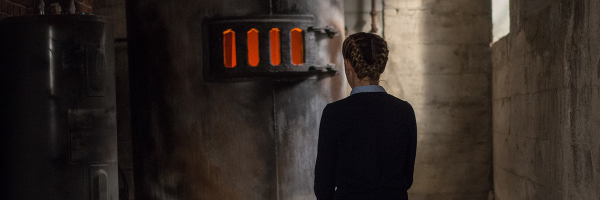
Braid (2019) (Category: Psychological) Braid is a childhood game gone wrong, carried over into young adulthood to find out just how twisted it can become. This is fever dream of betrayal and reluctant loyalty within the same breath, boasting vivid colors, neutral tones, and a score that's both sinister and sweet. It contains a minimal cast, but does the most with it, once again proving that less is sometimes more. It's also another female-driven horror/thriller in which the mind becomes a prison and the prison has a 'til death sort of mentality.
I have sort of a sordid past with the history of horror. Some of the movies that made their impressions on me at an early age were Dawn of the Dead, A Nightmare on Elm Street, Halloween, Psycho, Jaws, and The Shining. Horror and I have had an on again-off again relationship for nearly my whole life, but just in the past few years, my love for it has been rekindled. I created this list once before, but it needed updating. I created it again, and I accidentally deleted it. They say three times a charm. Or that three times summons Blood Mary. Either way, I guess.
10. The Cabin in the Woods (2011) The Cabin in the Woods is probably the wackiest horror movie I've ever seen. It's also probably the most original, and by original, I mean that it borrows from nearly every major horror movie of the '80s and '90s. How is that possible? I'm not sure, but whatever the formula was for creating this tongue-in-cheek gem, there should certainly be a lot more like it in the genre.
The Cabin in the Woods breaks out every cliche in the book, every trope we've ever seen in films like Hellraiser, An American Werewolf in London, The Strangers, The Grudge, Dawn of the Dead, Anaconda, and Jaws, throws it all in a blender alongside a government conspiracy and some age-old gods bent on human sacrifice, and then hits puree. The outcome sounds like it might be too busy, but it's stretched out well with tropey characters and excellent pacing. How might our lucky/unlucky survivors encounter all of the horrors listed above? TheCabin in the Woods finds a way to make it all happen, in all its vivid, bloody, chaotic detail. Pop this one in wherever you can find it and let the gory times roll.
9. Braid (2019) Braid is the newest addition to the list, and it is probably the most artsy, brought directly from the mind of French-born writer/director Mitzi Peirone. The scene to the left is a good representation of the demented skills Peirone brings to the table, chock full of both vivid colors and neutral tones and its fair helping of bloody fun. The score is both sinister and sweet, all within the same composition, which is really a fair glimpse of what the film has to offer.
Three childhood friends reconvene due to poor decisions of their own making, which only resumes the role-playing game they adhered to as kids. As children, the game was fun and silly. As young adults, it turns twisted and sinister, ushering in a fever dream of make believe and isolation. Braid is likely one of the most original pieces of horror I've seen, told completely through the lens of a feminine perspective. Braid ushers in a double meaning to its bold title, one that encapsulates the girls' twisted, rotting bond, and the tactics it takes to keep the three of them together forever. It's a childhood game gone bad for Daphne, Petula, and Tilda, one in which the three of them will have a difficult time breaking character with.
8. Hell House LLC (2015) Hell House LLC came in like a breath of fresh air to the found-footage sub-genre. It's an indie favorite, one that spawned a sequel, with a third in the works to complete the elaborate trilogy. Hell House LLC is a mockumentary, which meshes well the found-footage formula with a faux-documentary to bring the audience more details surrounding the sordid events at all the right times.
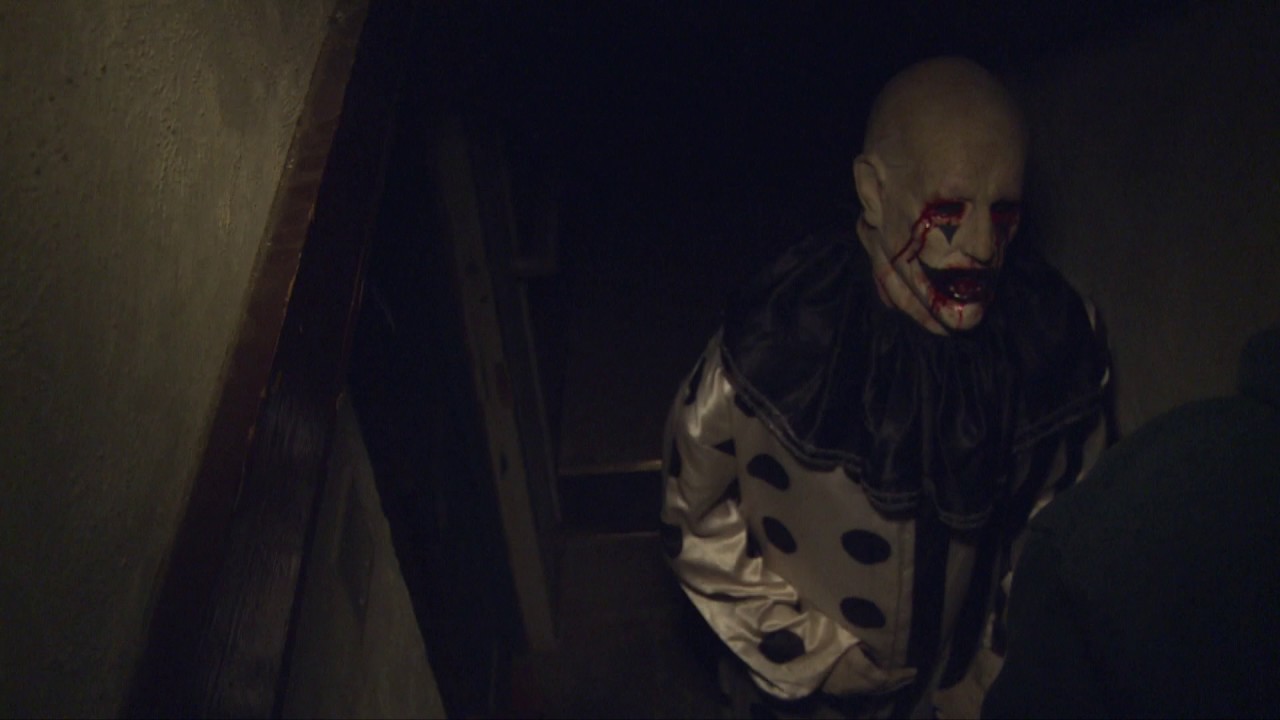
Alex, Sara, Mac, Tony, and Paul, collectively known as Hell House LLC, yearly create their own house of horrors around the greater New York City area for paying customers. A Faustian deal of sorts presently brings the troupe to the fictional upstate town of Abaddon, and more specifically, to the gutted, dilapidated Abaddon Hotel. But the old hotel is teeming with the specters of former guests, walking clown dummies, and demonic activity that lends itself to the demon that the town, and the hotel itself, is named for. Hell House LLC is floating around on Amazon Prime, and it's likely to not stick around much longer with the unlikely success of the hit indie franchise.
7. Starry Eyes (2014) Starry Eyes shines a spotlight on Hollywood fame, the great lengths one might be willing to go in order to achieve it, and all the sacrifices made to get there. It's a metaphorical trip through the dark underbelly of LA, where actresses flail from one casting call to another while the production directors they're trying to impress prey upon them. Starry Eyes is a horrific glimpse of social commentary, something between Rosemary's Baby and Neon Demon. Fame and fortune ultimately has its price, and this movie takes that concept to the nth degree.
Sarah Walker is an aspiring actress, supporting herself on her menial salary from a local fast food chain. When she answers a casting call, reading for a part in a horror movie called The Silver Scream, Sarah soon draws the attention of Astraeus Pictures. The production company gushes over her more self-deprecating tendencies, but she doesn't seem to mind. The stars beaming from her eyes slowly begin to blind her, and after an indecent encounter with the producer, Sarah begins to watch her life spiral out of control and into the hands of Astraeus. The pace is nice and the score is brimming with synths and '80s fervor, making for an exciting, original watch.
6. Darling (2015) I liked Darling a lot on my first viewing, but on my second, I was floored. Writer/director Mickey Keating avoids repetition with his movies, and Darling stands out in his canon. Though it was definitely influenced by Polanski and Hitchcock, I also see shades of Kubrick, as the title character shares similarities with Jack Torrance of The Shining fame. Much like Braid, Darling relies on a skeleton crew of actors, proving that sometimes, even with horror, less is more.
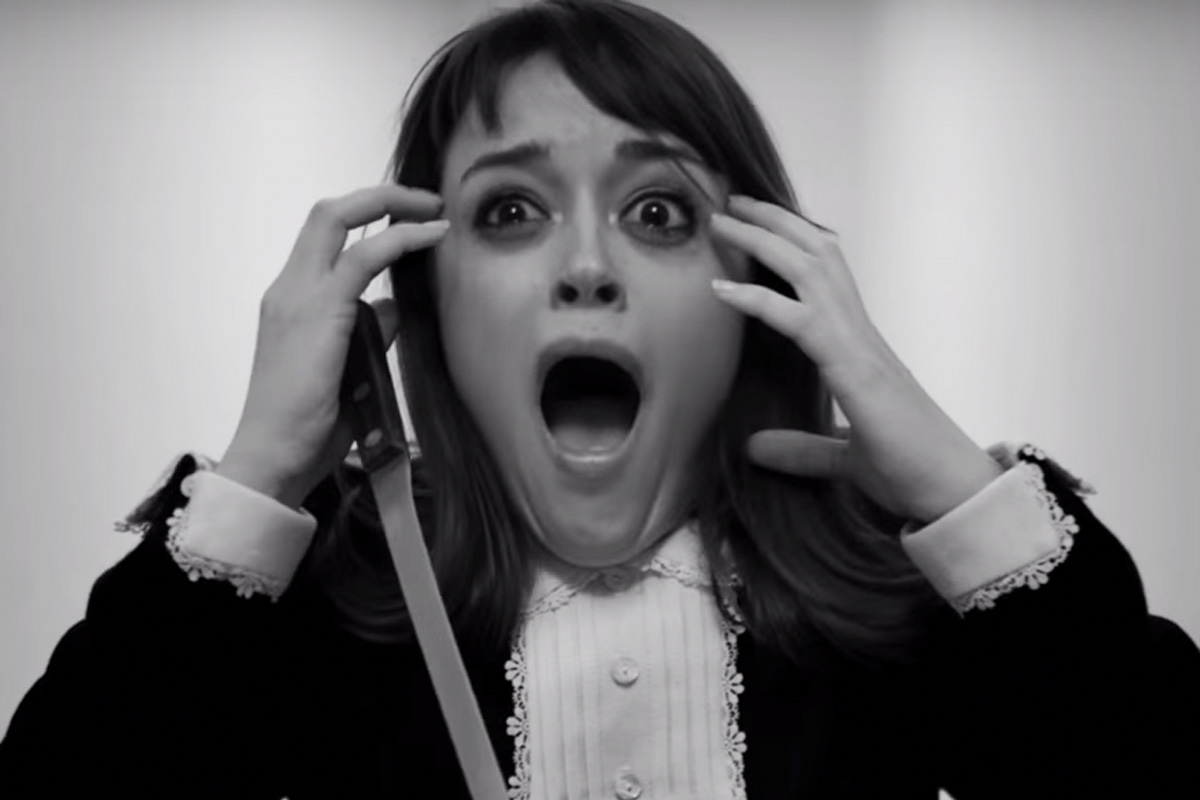
Less is also more with the monochrome direction. I can't imagine this story unfolding any other way. Darling is a quiet, mousy, mysterious caretaker for the oldest house in New York City, a mansion brimming with old ghost stories and an enigmatic locked door at the top of the stairs. The spirits resonating from inside the house begin to effect Darling, forcing her to see what's not there, to feel a paranoia that generates only from within herself, and to cast herself alongside the likes of the last caretaker who tended the old brownstone home. The old ghosts have their way with Darling, the catalyst being an upside crucifix she finds in her chest of drawers. Monochrome is creepy, especially in the case of Darling. The movie is stylish and unrelenting, the sample size of blood blanketed by a careful black and white lens.
5. A Nightmare on Elm Street (1984) A Nightmare on Elm Street was one of my first horror movies, it's protagonist, Freddy Krueger, my first dream demon. The premise, inspired by a true story frighteningly enough, was terrifying; the time that we're safe and comfortable and at most vulnerable, we're hunted down by a scarred dream stalker with razor hands and a fedora. My cousin insisted I watch this one before I was even ready for a movie of its magnitude, and while it certainly inspired my sleepless night, I now appreciate her influence.
Freddy Krueger is an evil entity who stalks the dreams on the Elm Street teenagers, forcing them to pay for the sins of their parents. Elm Street offers insidious images of the walking, talking dead wrapped in body bags, razor fingers scraping against the pipes of a boiler room killing zone, and an ensemble of jump-roping children singing their alms to Freddy in a creepy dirge that stays with the viewer. While the sequels saw to a wise-cracking Freddy, the original was scary, with Freddy's chimes coming more in the form of death threats. Protagonist Nancy makes for a great final girl, resolved to going mono e mono with the dream demon after growing tired of his bloody onslaught.
4. The Shining (1980) Another oldie but goody, The Shining is a horror movie brimming with isolation, hallucination, and a slow unraveling of the mind. The cinematography is creepy and desolate, the score is eerie, and the scalding image of the murdered Grady twins will stay with the viewer long after the credits have rolled. Though Stanley Kubrick's vision deviated from the original source material of the novel by Stephen King, I can't imagine the movie playing out any differently than it did. It's a haunting piece of vintage cinema, teeming with ghosts, isolation, and axes.
In a sense possessed by the spirit of Charles Grady, who murdered his family there ten years before, Jack Torrance undergoes a long, twisting decent into madness after he accepts the job of winter caretaker for the Overlook Hotel. He mingles with hotel guests and cryptic bartenders who aren't even there, and he seems to prefer their company to his wife, Wendy, and young son, Danny. He encounters empty halls filled with tidal waves of blood and the wrinkled old corpse of a woman in the ill-fated room 237. Jack Nicholson nails the part of Jack Torrance, lifting his name to stardom as a direct result. Stephen King disliked the portrayal, claiming that the Jack Torrance of novel had taken a slower, more tragic 180 turn for the worse. This would have been a nice touch for the film version, but Kubrick clearly knew what he was doing with this 1980 disasterpiece that goes down as one of the best of all time.
3. As Above, So Below (2014) Part Indiana Jones, part Dante's "Inferno," As Above, So Below treads new territory in the grander scheme of a found-footage flick. The idea is likely more scary than the actual movie; brilliant archaeologist Scarlett and her band of guides are on the hunt underneath Paris' infamous catacombs for a relic with healing powers and a tendency to grant eternal life.
There are definitely references to the works of Dante, the Knights Templar, and the literal hellish, claustrophobic network of crawlspaces and caves beneath the catacombs; the entrance to Hell itself, where the only way out is down. In actuality, more than one person has gotten lost in the catacombs, a winding labyrinth of human remains, which makes the atmosphere is this one slightly reminiscent of The Descent (another fantastic horror movie that just missed this list). As Above, So Below is currently showing on the Starz network, and is currently streaming on Netflix. If you love high adventure, tight spaces, and frightening visions of Hell where the past catches up to all involved, then pull the trigger on this one of a kind flick.
2. Scream (1996) Scream is considered a hit, and a cult classic all within the same breath. It's also probably the only movie in which you'll see Drew Barrymore die within the first 20 minutes. While a masked slasher with a knife hunting down teens in a small town seems far from original, Scream finds a way to bring new life to the premise. Like The Cabin in the Woods, it spends much of its time poking holes through overdone genre tropes, while its characters ironically fall into the same traps they're scoffing at.
Scream follows Sidney Prescott, whose mother was raped and murdered the year before the events of the story take place. The killer has just been exonerated and released from prison, forcing Sidney to question all she's ever known. This is about the time she starts receiving cryptic phone calls from a guy obsessed with scary movies. She is soon stalked by said guy, and her friends start dropping like flies in this whodunit-slasher with just as many laughs as dead bodies. Scream has a great sense of humor, penned by Kevin Williamson (the Scream sequels, I Know What You Did Last Summer, The Following), and directed by A Nightmare on Elm Street guru, Wes Craven. The sequels didn't have quite the same punch as the original, which is one of the greatest ever made in my humble opinion.
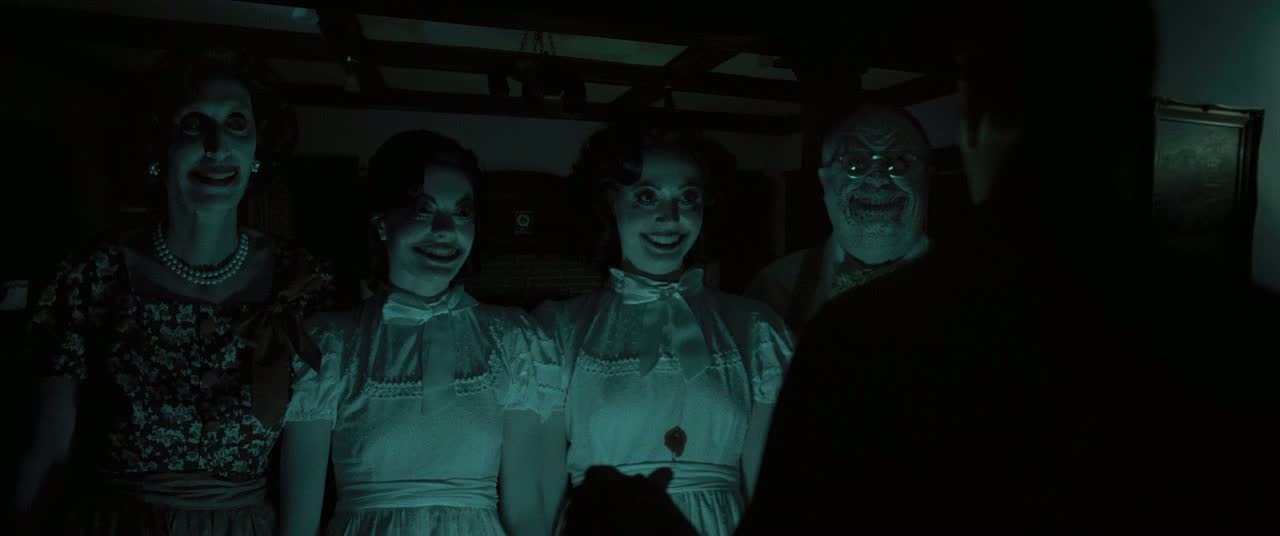
1. Insidious (2011) Insidious is probably the scariest movie I've ever seen. It incorporates all the elements that frighten me the most; demons, the ghosts of eerie, face-shifting twins, teen, Lizzie Borden-like family murderers from the 1950s, and old, wrinkly women in funeral garb. It takes all these things to make Insidious what it is, giving the audience multiple haunts to fear. It was the first movie to put horror maestro James Wan on the map, and with good reason.
Josh (Patrick Wilson) and Renai (Rose Byrne) are parents on the move to a new house. Their young son, Dalton, has a tendency for sleepwalking, and one fateful night, he unknowingly wanders into the Further - a dark, spooky place filled with demons and disjointed souls. Josh passed this trait onto Dalton, as he faced his own terrors as a child in the form of funeral attire-wearing wraith. With the help of Elise, who went on to star in the other three sequels, Josh gets to the bottom of the problem and willingly goes into the Further in order to deliver the comatose Dalton from it. Insidious, much like the rest of its franchise, and all the other James Wan offerings (The Conjuring, Annabelle), gives us several different entities to fear, which is what makes this so fun, and so terrifying.
I now have all three Hell House LLC movies splayed out before me, and I couldn't be happier. I've just finished watching them all back to back, and I have to say that it's probably my favorite horror franchise, even over the likes of Scream, Insidious, Halloween, and A Nightmare on Elm Street. The little indie found-footage film that could, the original Hell House LLC spawned two sequels, as well as a future streaming series called The Abaddon Tapes, based on individuals' experiences at the fictional, dreaded Abaddon Hotel.
The original Hell House LLC sees friends Alex, Sara, Tony, Mac, and Paul, otherwise collectively known as Hell House LLC, create and set up the haunted house experience for paying customers. Alex, CEO of the company, has made decent money around the boroughs of NYC, but now looks to take his frights upstate to the fictional town of Abaddon. Their trials and tribulations are told in a faux-documentary format, which doubles as a bold found-footage vehicle.
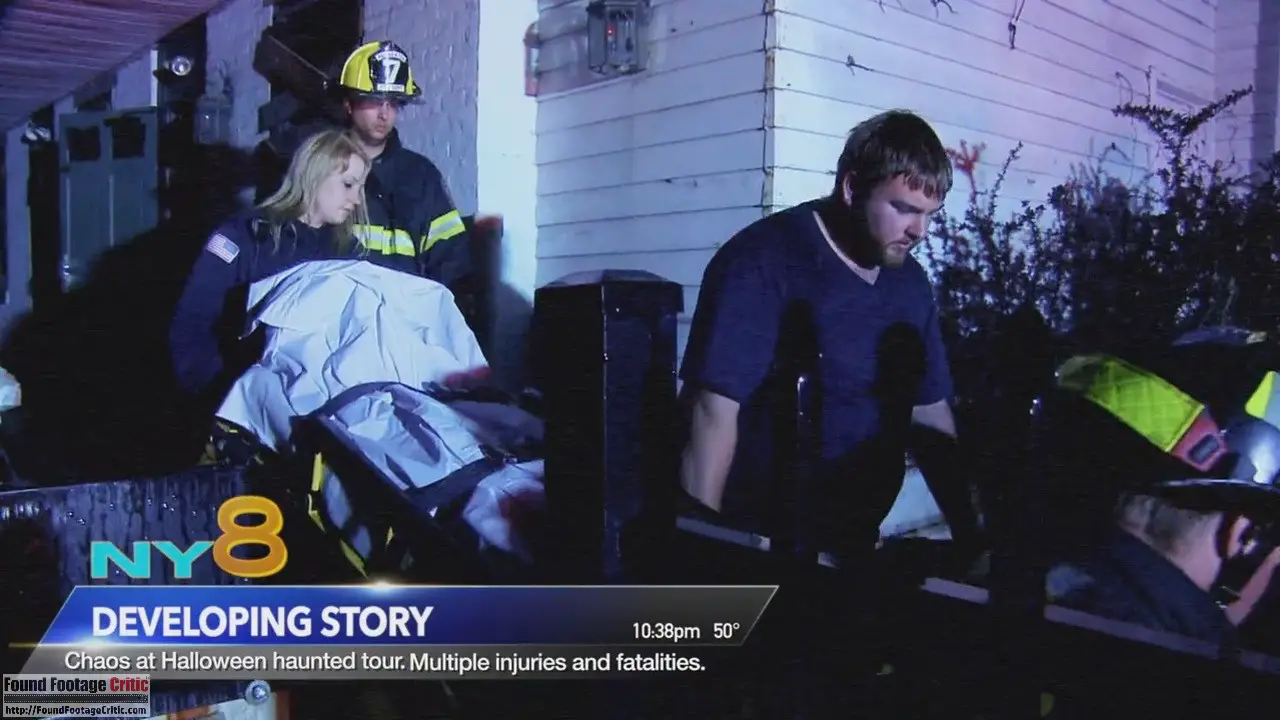
As the friends set up their house of horrors inside the abandoned, decrepit Abaddon Hotel, interviews and news footage floods in about the Hell House tragedy that occurred on October 8th, 2009, and about the checkered past of the creepy hotel. It was once bought by a man named Andrew Tully, who dabbled in the occult and stirred up some pretty nefarious elements that likely saw to some missing hotel guests. Meanwhile, friends Alex and Mac are constantly bickering back and forth about something, and it's not until the end of Hell House LLC II: The Abaddon Hotel that we find out why.
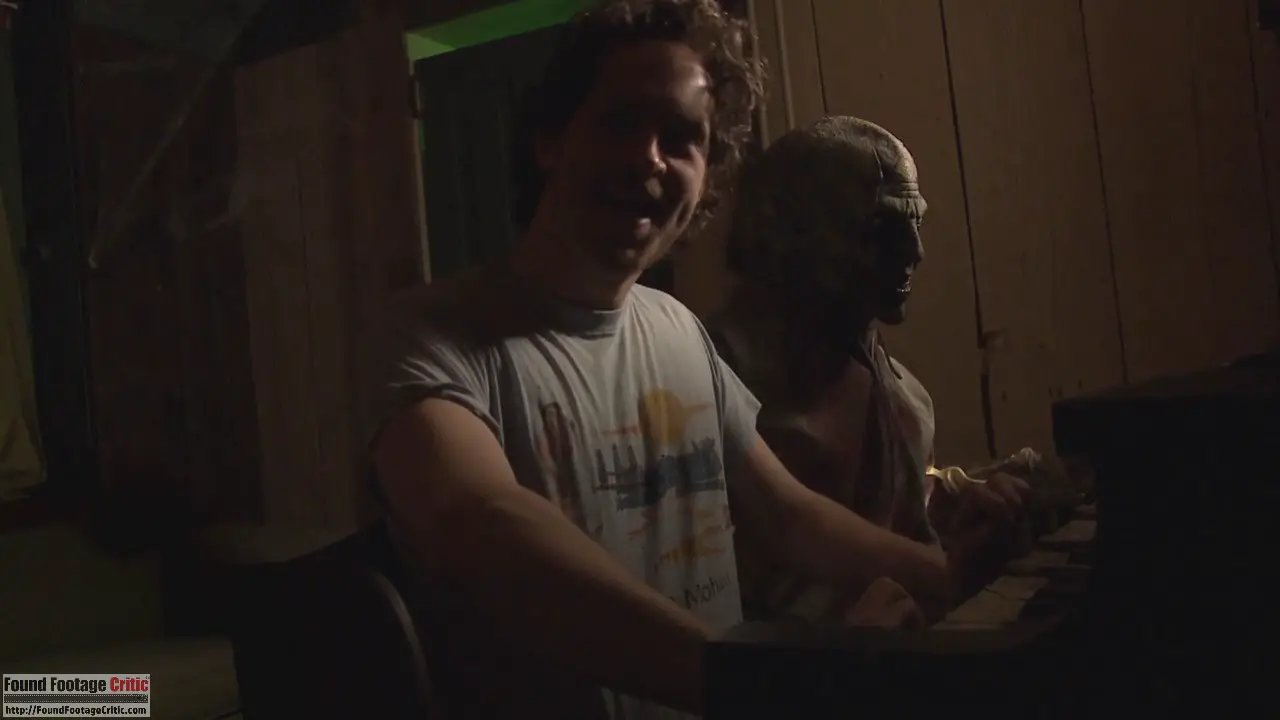
From August 23rd to October 8th, the crew rummage through the condemned hotel, staying in it every night while putting the finishing touches on its haunted tour appeal. The windows are boarded up, the walls are ramshackle, and the basement is riddled with old bibles and satanic graffiti. The company of friends takes one last toast before subjecting themselves to the scares of the abandoned hotel. They set up ghoulish mannequins of creepy women, killer clowns, and a creepy piano player Paul affectionately names Hector.
They hire actors to fill the roles of the dummies, but when one clown in particular gets up and walks on its own in the middle of the night with not an actor in sight, the friends start to get a little spooked - especially since the dummy's head doesn't move. This is when news trickles in from a new haunt actress about the hotel's past, which is also when we begin to see footage about Tully and his declining business, which subsequently led to the closing of the place.
Sara begins to randomly zone out, and Paul, who seems to be the most vulnerable to the horrors presented, experiences another paranormal dummy phenomenon that sees him run in fear and throw up all over the hallway floor. This was Paul actor's Gore Abrams' authentic reaction to the terror, and director Stephen Cognetti liked it so much that he decided to keep it for the final cut. It's a scary scene for sure, and the three scariest in the entire movie are all experienced by Paul. It's hard to blame the actor for his up-chuck reaction, but being that Paul is undoubtedly the biggest jerk of the crew, you hardly pity the character.
The scares keep coming for Paul before he up and disappears. The audience knows what happened to him, to some degree, but Alex and crew are left to wonder what has become of their cameraman. Things have already started to take a turn south, but Alex is focused primarily on the opening of haunted house, to the detriment of his friends and girlfriend. Pianos begin to play on their own, the same diddy that Paul ad libbed in the early days of the group's arrival.
It goes downhill from here as the group ready themselves for opening night. Sara has zoning out fits, Tony threatens to quit, and Paul returns completely and totally catatonic. Hell House LLC lets their crowd of haunt-goers in, but what results is a massacre. The screams and the chaos comes plentiful, the shaky camera all but holding on as demonic forces overtake the basement of the Abaddon Hotel. The members of the group are quickly picked off one by one at the dizzying pace of the melee, and like James Wan movies, Hell House LLC gives you multiple creeps to fear throughout the duration of the indie cult hit.
Hell House LLC II: The Abaddon Hotel picks up the terror with a mysterious disappearance inside the hotel in the aftermath of the first film, along with a subconscious piano lick of part I's leitmotif, originally played by Paul when introducing himself to the dummy Hector. It's an otherwise benign diddy played by a child, but is made eerie by the creative wiles of Stephen Cognetti. The host of an Abaddon, New York morning talk show welcomes a panel onto her show, consisting of a town councilman Arnold Tasselman, Mitchell Cavanaugh, the documentary filmmaker who pieced together the footage from the first movie, and a psychic medium. The interview is spotted by the journalist duo of Jessica Fox and Molly Reynolds, who bank on the fact that Mitchell, the Hell House documentarian, will take them back inside the hotel. Mitchell believes that something sinister lurks in the Abaddon, though Tasselman writes it off as the result of natural malfunctions.
The town maintains that there is nothing wrong with the hotel, though police cars are kept at the exterior at all times to dissuade urban explorers and journalists alike. That doesn't stop Fox, Reynolds, Cavanaugh, and the psychic medium, Brock Davies, who invites himself into the fold. Before they make their decent, a stream of videos begin flooding in, ones of daredevils and unfortunate Samaritans tempting fate and the supposed horrors of the Abaddon to come out and play - all with dire consequences. Whether the journalists know about the videos or not, it won't stop them from gaining access to the truth about the Abaddon.
The group plans to break in through the back door, but it has been left open. The after footage is then shown, one in which an in-shock, catatonic Jessica Fox is being interviewed. Segments are spliced in here and there to keep the audience on the line, a trick Cognetti uses to his advantage. When Brock comes across the dining room, where hotel owner Andrew Tully hung himself thirty years earlier, a pair of nooses drop from the ceiling - a macabre invite to forever join the cast of Hell House LLC. They are also soon joined by an unexpected guest, one that freaks them, and the viewer, out completely.
Meanwhile, in the basement refrigerator, Jessica, Mitchell, and their cameraman retrieve the lost tapes they were looking for, but when they try to leave, the killer clown dummy, the same one that introduced its animate scares to Paul in the original film, rears its head - literally.
Making their way to an exit, any exit, proves an ominous task, especially with a former hotel guest stalking their every step. She/it also plagued Paul's existence, much like the killer clown. But the two are the least of their fears when reintroduced to the dining room and Faustian deal that's finally revealed to the audience. Alex and Mac from the first film play key roles in the completion of the second, which does well to tie the current horrors back to the original, in more ways than one. Alex and Mac are seen arguing several times in the first film, and it's the second that we finally understand what the animosity was all about. The final third of Hell House LLC II: The Abaddon Hotel sets the stage perfectly for the encore, Hell House LLC III: Lake of Fire.
A year after the events of the second film, the Abaddon Hotel is set to be demolished, or so the opening info of Hell House LLC III: Lake of Fire tells us. The movie begins by mentioning the tragic events of October 1st, 2018 at the grand opening of Insomnia, where a familiar town resident and author of The Abaddon Tapes from the first film, Robert Lyons, recounts how billionaire and host of the interactive show Insomnia, Russell Wynn, has purchased the ill-omened hotel. The show is essentially an interactive play with actors in a modern retelling of the classical tale of Faust.
To bring things full circle, the cast of Faust are interviewed while we're shown snippets of absolute horror from the first film. It's a nice reminder of the scares that led up to the carnage of October 8th, 2009, and the chaos that followed, featuring the team of journalists, documentary filmmakers, and psychic mediums. Vanessa Shepherd, the new host of the local show Morning Mysteries, films and chronicles Russell Wynn's creation of Insomnia at the Abaddon, much like the creation of the original haunted house experience that members of Hell House LLC were setting up in the original.
Unlike the original Hell House LLC, the Faust actors aren't asked by Wynn to stay the night. The original footage plays as a local legend, with one cast member, Max, likening the whole experience to "doing Julius fricking Caesar at the theater of Pompeii ruins." The newest Morning Mysteries footage takes place from September 13 to October 2, the day when the repeatedly shocking mayhem of the Abaddon comes to a head. The chaos begins when Max, who plays Mephistopheles, and Gregory, who plays Faust in the production, prompt actress Jane to go inside the Abaddon after dark - a notion that Russell has forbade the actors from doing. Moving dummies and the familiar piano dirge from the original movie welcome her in and serenade her kissing one of the killer clown dummies - to another familiarly shocking conclusion. Make-up artist Isabel also meets with some of the old spirits before too long, including Sara from the first movie. Alex, Tony, Mac, and Paul also find a way to show up, as well as journalist Jessica Fox from part II.
It's almost as if Russell knows something bad is coming on opening night, and he tells Vanessa Shepard as much in so many words. Meanwhile, he has charmed his spooked crew back into the fold with his every man essence, pulling them together one last time the night before the opening. When the Insomnia theater officially opens its doors to the public and Faust begins to make his deal before a novelty-masked live audience, all hell literally breaks loose in the bloodiest, most chaotic finale that the Hell House LLC trilogy has to offer. All bad CGI moments aside, Russell proves to play a key role in the gateway to Hell, and Stephen Cognetti comes full circle with his characters and his three-part story.
Companies make deals all the time, and while the first two films gives glimpses of the metaphor, Hell House LLC III: Lake of Fire closes the Faustian deal, bringing things to a satisfying conclusion, one that's almost a relief, but at the same time highly unsettling. The first film is a modern classic, the second features of people who have tried their amateur luck against the hotel, and third brings things full circle in a finale for the ages. Like Mickey Keating (Darling, Psychopaths, Carnage Park) and Oz Perkins (The Blackcoat's Daughter, I Am the Pretty Thing That Lives In the House), Stephen Cognetti is an indie writer/director on the rise. His next project is called 825 Forest Road, another haunted house vehicle set to begin filming in PA in the spring of 2020. With the Hell House LLC trilogy in the books, Cognetti has given me my favorite horror franchise to date, and has turned me into a devoted fan of his future projects.
The horror genre has found new and innovative ways over the years to infiltrate our deepest fears, and to make us weary of sleep. I'm always on the lookout for these types of efforts, especially when they pertain to the arts. There are a few out there that focus on art, dance, music, drama, and fashion, so I've chosen to highlight a few here for their contributions to the cause.
5. Velvet Buzzsaw (2019) Velvet Buzzsaw is as brutal as it is comical as it is purposely pretentious with its obnoxious, highbrow art dealer characters. The most interesting aspect of the film is the artwork of the enigmatic Vetril Dease, whose morbid, posthumous paintings begin to set the world of art ablaze. In the immediate aftermath, eccentric and oddball pieces of art come alive to torment its worshipers, perhaps for exploiting it in the first place. The death scenes are creative and campy, and one is even pretty nasty, even though the screen cuts to black before we see the bloody aftermath. It does seem to venture slightly off-track as we get closer to the end, but the climax is nonetheless satisfying, leaving the viewer to figure out the film's bigger picture. Velvet Buzzsaw is about the dire consequences of exploiting and manipulating art for our own gain.
4. The Black Gloves (2017) The Black Gloves might speak to you if you know or appreciate the ballet "Swan Lake," or if you enjoy monochrome movies filmed in the modern day, or if you're a fan of Alfred Hitchcock. It follows Finn Gollaway, a Scottish psychologist who's become obsessed with shell shocked, former "Swan Lake" ballerina Elisa Grey, tormented by the "Swan Lake" baddie himself, Owlman. An isolated mansion, overbearing madams, constantly howling wind, black and white horror that manifests from the unsuspecting corners of the frame shape this little-known effort into something special.
3. The Devil's Candy (2015) The Devil's Candy tackles a musician/painter in Jesse Hellman (Ethan Embry), a metal head husband and father who's just moved his family into a new home. But as it turns out, the home formerly belonged to Ray Smilie, who hears demonic voices telling him to take back the house he killed his parents in, and to kidnap and murder local children, the Devil's candy. Jesse and his daughter Zoe love metal music, and possessed by his own demons, Jesse creates some pretty monstrous, morbid pieces of art himself.
2. Suspiria (2018) Suspiria is a remake of the '70s Dario Argento original, though it really takes on a life of its own. Set during the turbulence of a post-WWII German civil war, the movie centers on an exclusive dance studio and the tight-lipped witches who run it. The witches vote in a new leader every so many years, and as they welcome in a rare new talent from the US (Dakota Johnson), they ready themselves for a change that they will not soon recover from. I haven't seen the Dario Argento original, but I can't see how it could be any better than the remake. The fact that Thom Yorke scores the movie entirely may or may not have something to do with that. Also, Tilda Swinton plays three different roles.
1. Starry Eyes (2015) Starry Eyes focuses on the art of acting, and it's set in Tinseltown itself. Sarah Walker is a struggling actor, attending one casting call after another in search of her big break, all while working a dead end job as a waitress. When she receives a call back for all the wrong reasons, she's overwhelmed with joy, and she goes to some pretty desperate links to make her dreams come true. Starry Eyes is one of my new favorite horror films, completely original in its take on the genre. The score is also very retro 80s, and most of the terror comes in how in this particular case, at least metaphorically, art really does imitate life. It's another cautionary tale on the treatment of desperate actresses at the hands of greedy, powerful producers.
10. The Fairy (The Haunting of Helena) The Fairy, an Italian woman living in Mussolini's Fascist regime, is brutalized by her husband after she smiled at another man. He beat her mercilessly and pulled out all of her teeth one by one before locking her in a closet to starve and waste away. Now, she's after the young Helena, and more specifically, after a whole new set of teeth to replace the ones she lost when she was still alive. The Fairy is a lesser known entity, but is no less scary for it in the little known Amazon Prime streamer.
9. Diana Walter (Lights Out) Lights Out is based on a short film, which was actually better than the full movie. Though, the producers did create a pretty frightening entity in the dark-craving Diana Walter, whose debilitating skin disease and subsequent maltreatment at the hands of hospital staff gives her the will to haunt, and to kill. The actual movie is pretty much trash, but Diana still manages to be a frightening enough malevolence, stalking the dark with her eerily-lit eyes and long, claw-like fingernails.
8. The Bride (Annabelle Comes Home) One of the scariest aspects of The Bride, which may or may not even be her name, is that she really doesn't have a backstory. Like so many of the creatures and killers in The Cabin in the Woods, The Bride's murderous rage is left to our imagination as an unleashed Annabelle reanimates her will to kill and maim. All we know is that a cursed wedding dressed possesses every woman who wears it to kill a host of new husbands. I can only hope that James Wan and the other creators of Annabelle will pitch us a standalone story of The Bride, similar to what they did with Valak from The Conjuring 2, and with the upcoming The Crooked Man, also a creeping oddity featured in The Conjuring 2.
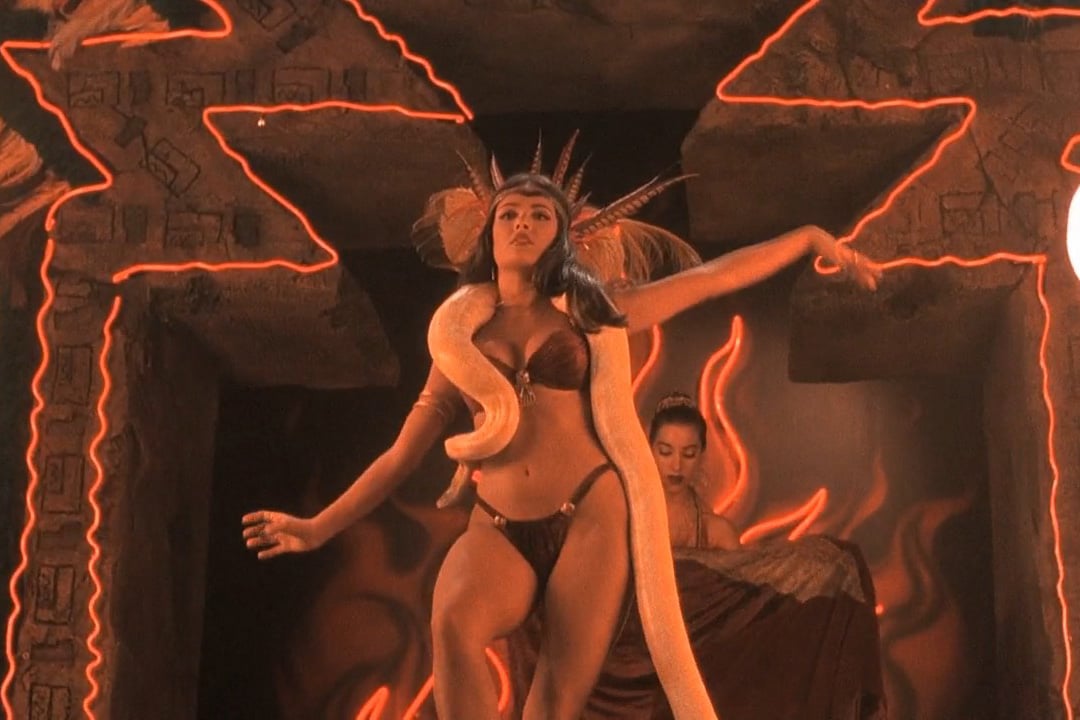
7. Santanico Pandemonium (From Dusk Till Dawn) She's sultry, she's sexy, and she's serpentine, not to mention that she can morph into a vampire at the drop of a hat. From Dusk Till Dawn is as campy a horror movie as they come, but it's a lot of fun nonetheless, with Santanico providing house entertainment at the Titty Twister. She seems to have a thing for Richie Gecko, and the television series takes that fascination a step farther. Salma Hayek was born to play this role, as minor as it may be, with her headdress and her albino bao and that tequila down the leg trick.
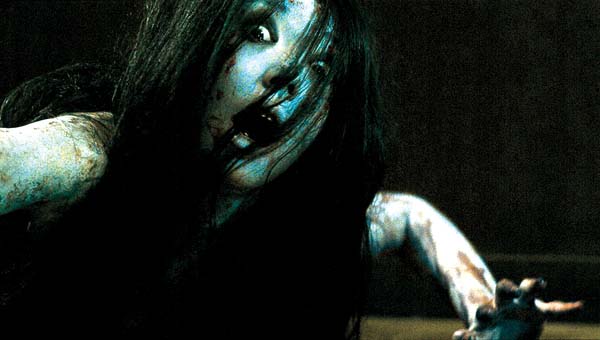
6. Kayako (The Grudge) From sexy to sinister, we head to The Grudge baddy, Kayako. After being abused and strangled by her jealous husband, Kayako returns as a malevolent entity, hallmarked by her throaty rasp, one that continues to haunt viewers to his day. Like The Ring, The Grudge was a Japanese remake for an American audience, and boy, were we terrified. Kayako pops up where you least expect her, including in your bed and crawling destitute down your staircase.
5. The Angry Princess (13 Ghosts) The Angry Princess, or Dana Newman, was a tragedy of her own making. She could never be quite beautiful enough in her own mind, which is why she engaged in breast implants and nose jobs and countless other procedures. When she attempted another procedure on her own, it left her blind in one eye. She then went home, climbed into her bathtub, and slashed herself with a knife until she bled out. Abusive boyfriends were also part of the equation, which might explain why the princess was so angry. That, and seeing other people who didn't have to endure the things that she did during her lifetime.
4. Edith Brennan (Mama) Edith is the only entity on the list who is completely CGI. She still manages to be pretty scary in her looking after feral children Victoria and Lily. Edith is a jilted former asylum patient whose child was taken away from her, so ever since her death, she's been haunting the woods, searching for a child, or children, to inflict her maternal instincts upon. She takes an overprotective nature to the extreme in Mama, resulting in a few deaths along the way.
3. Valak (The Nun/The Conjuring 2) Valak was pretty frightening when she first appeared in The Conjuring 2. She was the scariest thing about the movie. Taking the audience response to her and running with it, producers quickly cooked up and crapped out a standalone movie called The Nun, which was wholly disappointing. Valak is a demon who has possessed a Romanian nun, one who animates from cryptic portraits and floats down long hallways to bring forth her doom and gloom.
2. Mary Shaw (Dead Silence) "Beware the stare of Mary Shaw, she had no children, only dolls, if you see her in your dream, be sure you never, ever scream or she'll rip your tongue out at the seam." This is the nursery rhyme that accompanies Dead Silence, the horror movie featuring the frightening antagonist Mary Shaw. She was a ventriloquist who grew ill at a child heckler, whom she kidnapped. The townspeople of Raven's Fair then rushed her and ripped out her tongue, silencing her forever. She was then buried with all 101 of her dolls, but continued to plague the town as a menacing poltergeist.
1. Madeline O'Malley (The Innkeepers) Madeline is the most frightening entity on this list, and she also probably receives the least amount of screen time. She is a 19th-century bride who was jilted at the altar and promptly hung herself at the Yankee Pedlar Inn, a once-grand hotel on the verge of closure. Madeline haunts the basement of the hotel, where her body was brought by the owners out of fear that her death would drive away business. The Innkeepers as a whole is not very good in my opinion, though it did feature quite an antagonist with the ghost of Madeline O'Malley.
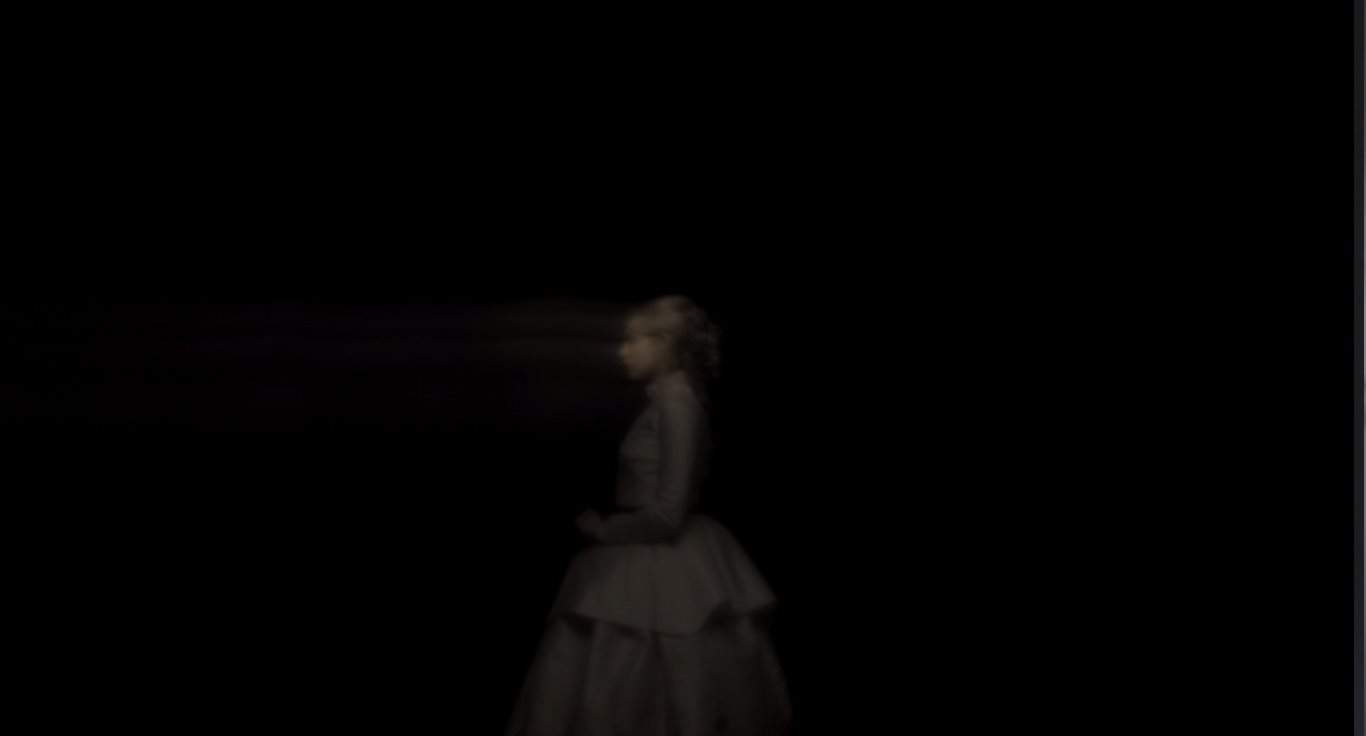 This was the first horror movie I had ever seen to delve completely into the damaged, confused psyche of an apparition. It's basically a character study in the midst of a slow-burn, atmospheric ghost story, but for the first time, writer/director Oz Perkins shifted into the mindset of an wayward spirit with haunting, poetic prose narration and a score that's cold and unsettling. Perkins takes the paranormal ghost story and flips it on its head here.
 The premise isn't really all that original, but the casting decisions are. The only male we really see comes as a short, snippet means to an end, giving background information and character development for the lead, Sarah. The movie, tough as nails and bloody as heck, is carried by an all female cast, battling a brood of humanoid bat-like creatures down in the bowels of the earth. The twist ending also alludes to the fact that we're not only trapped in a creature feature, but a paranormal haunter as well.
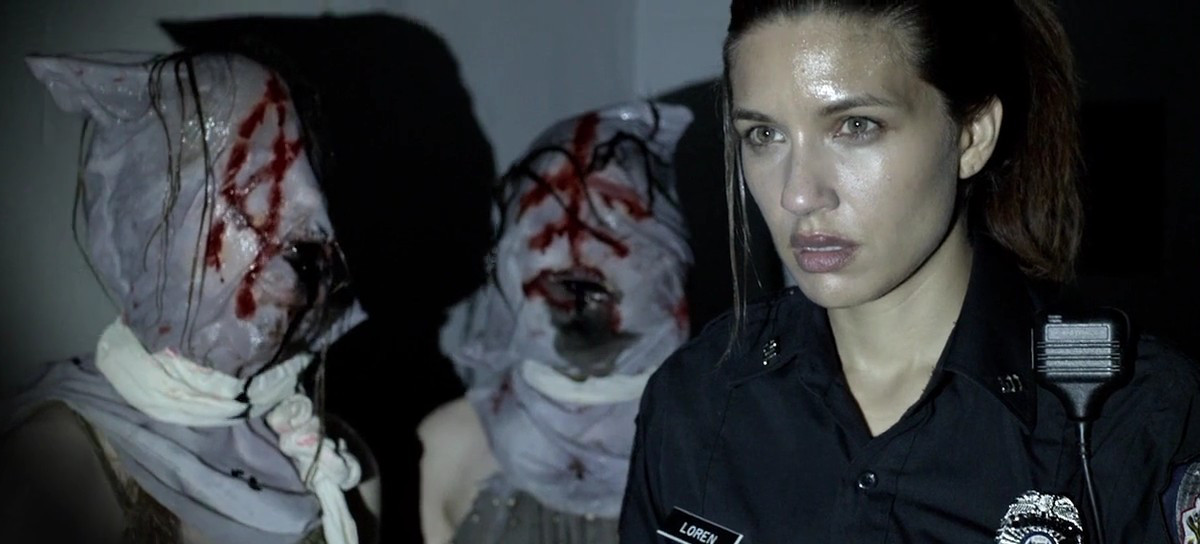 Writer/director Anthony DiBlasi makes indie horror gems in his sleep, including this one, Extremity, and the little-known psychological torture-twister, Dread. His first, The Last Shift, takes the Manson Family, throws them into a satanic blender, and tosses in an ounce of ghost story. The end result is every bit as brilliant as it sounds.
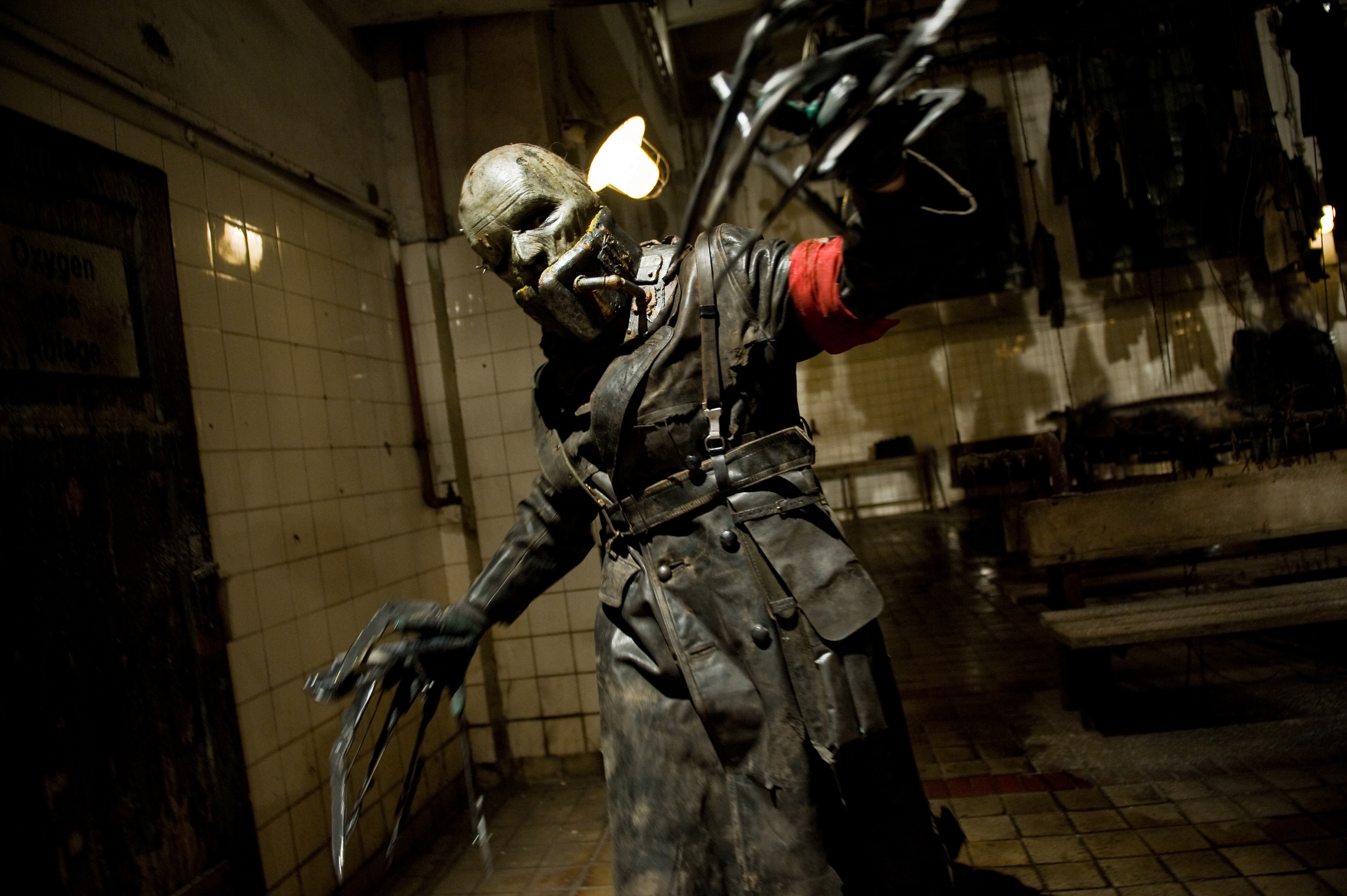 Frankenstein's Army is an original take on the found-footage sub-genre, taking a group of Soviet soldiers through the wartime horrors of dead soldier reanimation. There's nothing worse than a Nazi, except for maybe a walking dead Nazi fused to iron claws, plane propellers, and industrial-sized drills. This is one of those "what am I watching"-type flicks, but one in which you find yourself surprisingly charmed by the time the credits role.
 Mortal Remains is based on the lore surrounding the lost black and white horror film, Fury of the Demon. The film explores the defamed legend of the infamous gore director Karl Atticus, who supposedly used real corpses in his movies, which have been banned and have disappeared completely. Interviews reveal the eerie mystique of Atticus and his film adaptations of an Anton LeVey/Aleister Crowley-inspired occultist author. This really plays more like a documentary than a movie, which is a brilliant approach.
 The Blackcoat's Daughter is about as organic and grounded as a demon horror flick gets, making it all feel very real. Another atmospheric slow-burn from the demented mind of Oz Perkins, this one keeps it real on so many levels, jumping back and forth in time for a shocking, ambiguous, open-ended conclusion.
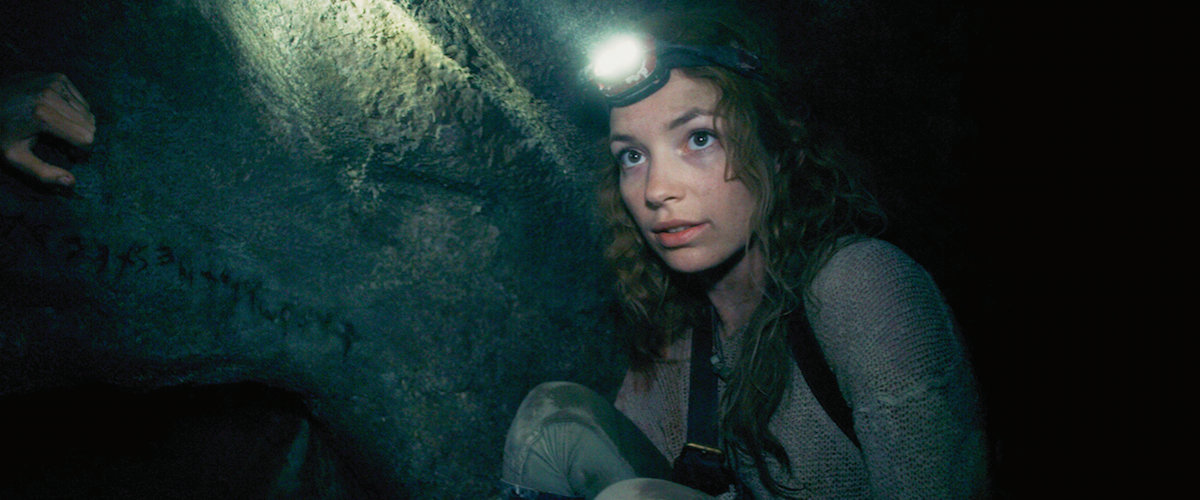 I love this one not only because it focuses on the Paris catacombs, not only because the heroin is a brilliant, adventurous archaeologist, but that it reminds me so much of the Indiana Jones flicks I grew up on. Part adventure, part claustrophobic, psychological nightmare, this one is one of my all time favorites.
 Starry Eyes is Rosemary's Baby meets Neon Demon, but it's completely original, as it imagines how success comes with personal, and literal, sacrifice. It's a highly metaphorical gem that pits Sarah Walker (Alex Essoe) against Hollywood itself, and old school producers with ominous hand brandings. It also makes room to incorporate some good, old-fashioned body horror, and it has a killer retro score in a day and age re-surged by the Stranger Things phenomenon.
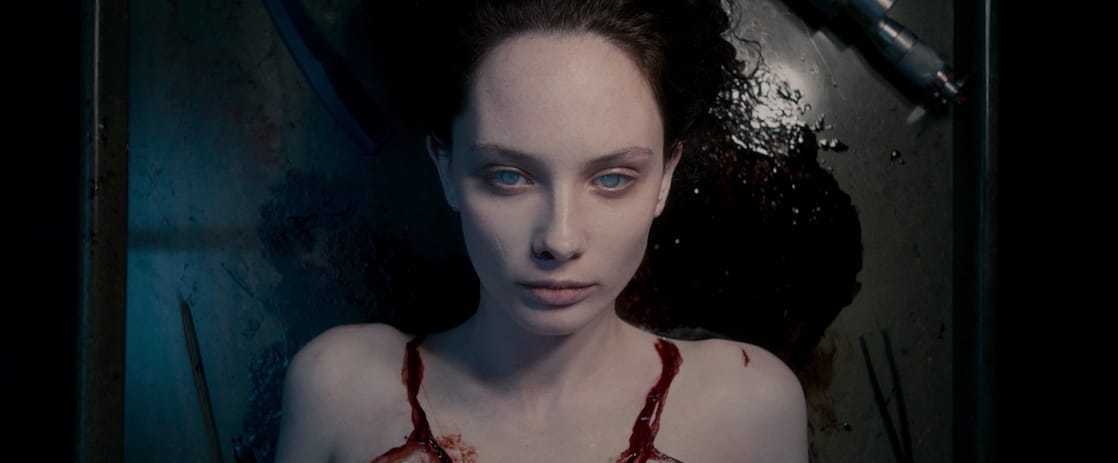 The reason this one is so original is because all the calamity and chaos that follows a father and son team of coroners is spurred forth from a faraway-staring, opaque-eyed corpse. Jane Doe never moves an inch, but sets forth the downfall of the duo with absolute repose. Give this one a shot on Netflix and be dazzled.
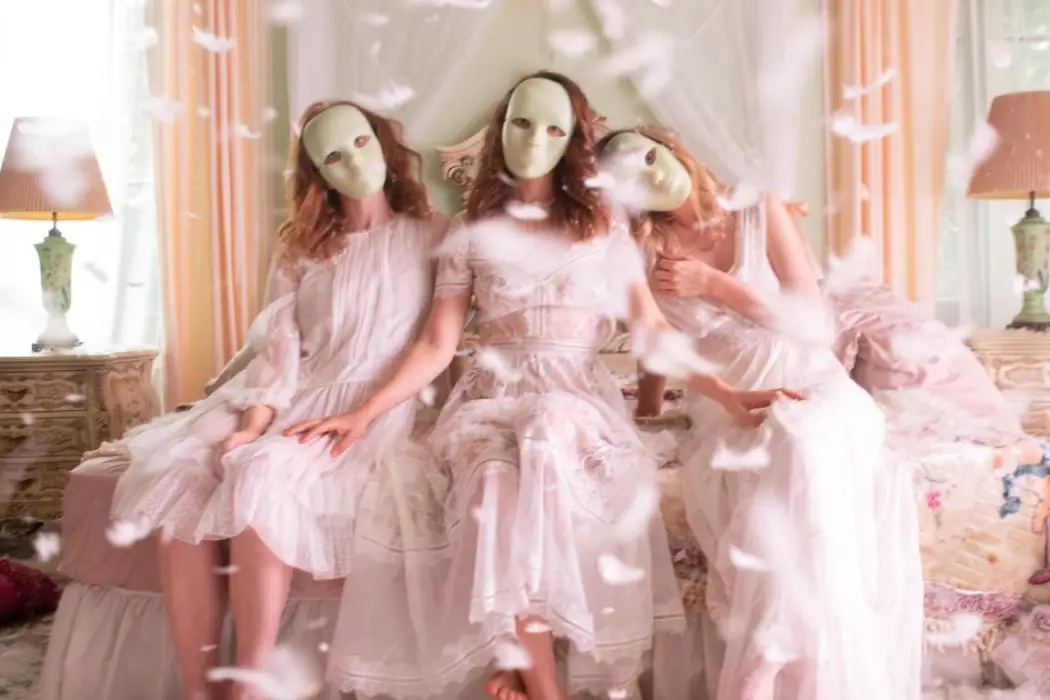 Braid is a childhood game gone wrong, carried over into young adulthood to find out just how twisted it can become. This is fever dream of betrayal and reluctant loyalty within the same breath, boasting vivid colors, neutral tones, and a score that's both sinister and sweet. It contains a minimal cast, but does the most with it, once again proving that less is sometimes more. It's also another female-driven horror/thriller in which the mind becomes a prison and the prison has a 'til death sort of mentality.








/cdn.vox-cdn.com/uploads/chorus_image/image/62983761/Screen_Shot_2019_02_01_at_4.14.30_PM.0.png)